
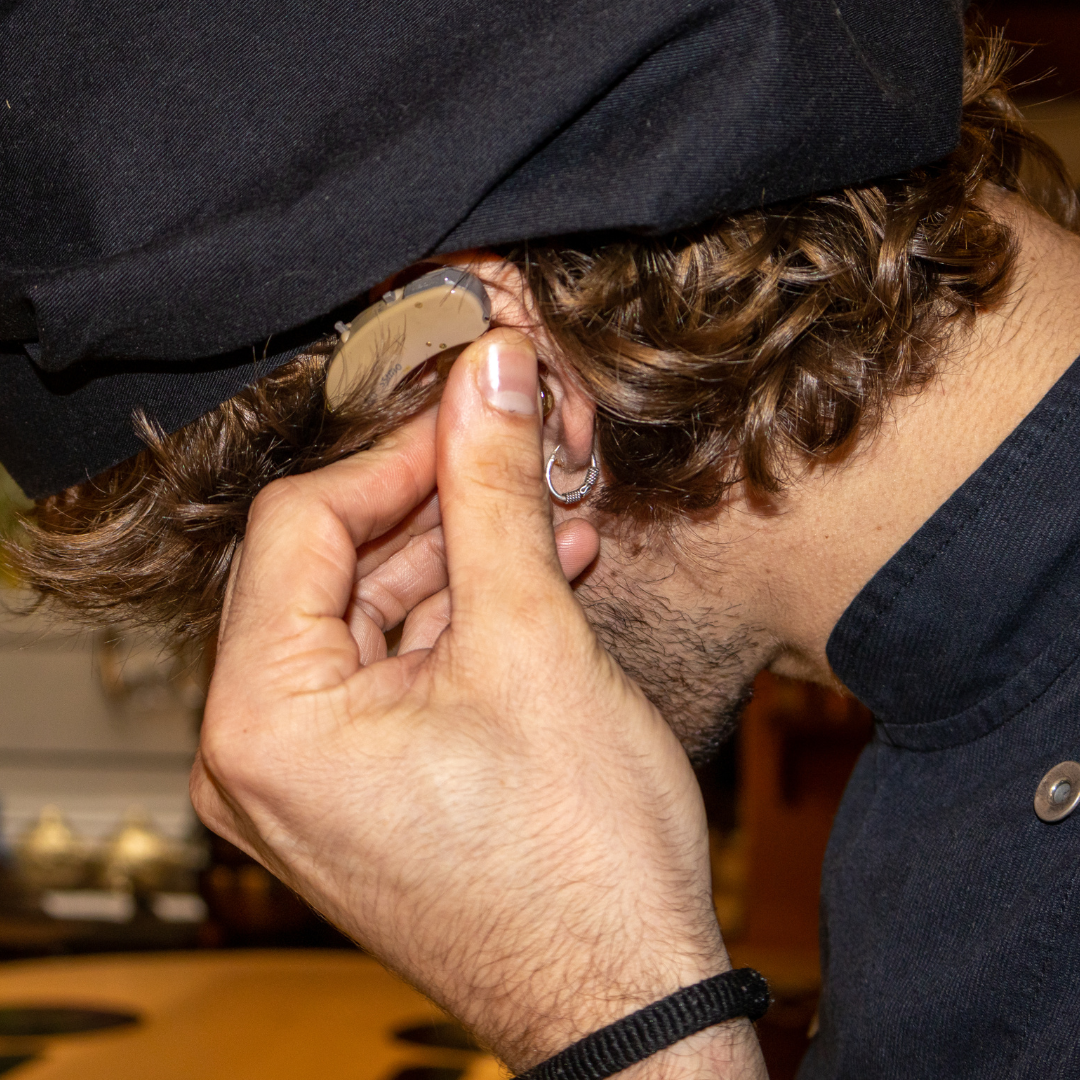
Group discussions in restaurants often become difficult to comprehend when room acoustics compete with your focus and hearing. Our audiology clinic conducts specialized testing to evaluate hearing in both quiet sound booths and noisy simulations to isolate the underlying cause. Once we determine the cause of difficult hearing, we can help you find personalized solutions.
Why Do I Hear Well in Quiet but Struggle in Restaurants?
A quiet setting creates an optimal signal-to-noise ratio, ensuring the conversational partner’s voice rises cleanly above ambient sounds. Modern restaurant environments create the complete opposite listening environment. Layered diner voices, kitchen activity, foreground music, and room reverberation muddy speech signals, requiring intense mental strain to follow dialogue.
Such listening challenges typically stem from high-frequency hearing loss, auditory-processing deficits, or accumulated noise-induced trauma. Cognitive exhaustion, physical fatigue, low ambient lighting, and increased distance from your conversational partner further compound the challenge. Many individuals register normal audiometric thresholds on standard pure-tone screenings yet show profound deficits during speech-in-noise testing. Experiencing speech-recognition struggles in noisy dining venues warrants a formal audiological evaluation regardless of seemingly normal quiet hearing.
The Audiological Process for High-Frequency Hearing Loss
Diagnostic assessment begins by documenting specific listening breakdowns, recreational noise exposure, tinnitus symptoms, medications, and hereditary auditory patterns.
Pure-tone audiometry measures the softest sounds you can hear at different pitches through air and bone conduction. In high-frequency hearing loss, the audiogram reveals a sloping configuration where hearing acuity drops progressively as pitch frequencies increase. Comprehensive evaluations frequently include impedance tympanometry to examine middle-ear function and recorded word-recognition testing to measure speech understanding.
Because a quiet booth does not recreate a busy dining room, speech-in-noise testing can add valuable information. This procedure gauges speech-discrimination accuracy while competing multi-source noise becomes incrementally louder. Together, these audiological findings indicate whether the issue involves sound audibility, speech intelligibility, noise-processing dysfunction, or multiple compounding factors.
Auditory Processing Disorders: Impact on Adult Communication
A central auditory processing disorder disrupts the neurological transmission and cognitive interpretation of sound waves. While peripheral ears may register soft tones normally, the auditory cortex struggles to filter competing noise, resolve phonetic contrasts, or keep pace with rapid conversation. We systematically verify peripheral hearing health before establishing whether an advanced auditory-processing evaluation or medical referral serves your needs.
Effective Techniques to Hear Better in Noisy Surroundings
Small changes can improve the signal reaching your ears and provide clearer visual cues. Prior to dining, choose venues known for lower noise levels or schedule meals during quieter dining hours. Settings constructed with comfortable booths, acoustic ceiling panels, drapery, and carpeted walkways facilitate easier communication than open venues with concrete and glass.
At the restaurant:
- Ask host staff for a quiet table distanced from kitchen traffic, bar noise, audio speakers, and loud group tables.
- Position your chair against a perimeter wall to diminish competing auditory chatter behind your head.
- Ensure you sit directly across from speaking partners in an area with sufficient illumination for visual lip-reading.
- Minimize the physical gap separating you and the person speaking as much as reasonably possible.
- Position your better-hearing ear directly toward your main conversational partner.
- Ask the speaker to rephrase the missed portion instead of repeating everything.
- Validate significant pieces of information directly rather than feigning understanding during dialogue.
- Step into a quiet area for a few minutes when listening fatigue begins to compromise focus.
- Request that friends speak with crisp clarity rather than speeding through dialogue.
- Speaking with excessive volume creates acoustic distortion that fails to make words clearer.
The Best Hearing Devices for Overcoming Restaurant Noise
Selecting the ideal assistive technology depends upon underlying diagnosis, specific acoustic challenges, and verified hearing loss. Advanced hearing aids utilize beamforming directional microphones, adaptive noise reduction, and specialized restaurant programs to elevate voices directly ahead while suppressing ambient chatter. Patients must uphold realistic expectations because modern amplification cannot strip out every ambient human voice completely.
Utilizing an external remote microphone can deliver a dramatically superior signal-to-noise ratio. Worn on the speaker’s collar or set on the table, the microphone broadcasts direct audio to paired hearing aids or specialized receivers. This strategy bypasses the detrimental effects of room reverberation, distance, and localized background chatter.
Additional effective assistive technologies include:
- Omnidirectional table microphones designed for group dining tables
- Telecoil components connecting directly to public hearing-loop systems
- Mobile device live-captioning programs and speech-to-text transcription software
- Consumer wireless earbuds or hearables featuring customizable assistive listening modes
- Decibel-level applications and restaurant rating guides for finding quiet tables
We evaluate these technological options, ensure full hardware compatibility, and instruct you on maximizing your selected system.
Clinical Audiology Care for Hearing in Complex Noise
A comprehensive hearing evaluation looks far beyond the common misconception of “I hear fine in quiet environments.” We analyze the exact social venues, voice registers, and noise environments that cause difficulty to administer tests matching your lifestyle. Your comprehensive workup may involve pure-tone hearing thresholds, middle-ear testing, recorded word recognition, and speech-in-noise measures. Diagnostic auditory-processing testing may be recommended if your clinical symptoms and baseline evaluations suggest central auditory dysfunction.
Any sudden, asymmetric, or rapidly deteriorating hearing loss demands immediate medical evaluation by an ear, nose, and throat physician. Dedicated individualized care pinpoints the underlying auditory cause rather than dismissing your struggles as standard restaurant noise.
Request an Audiology and Hearing Evaluation Today
When dining out causes you to guess at words, detach from family, or experience severe listening exhaustion, book a comprehensive hearing evaluation with us. We will help you navigate hearing in noisy environments by implementing advanced hearing aid options, assistive accessories, or therapeutic auditory strategies tailored to your lifestyle.
Contact our audiology office today to schedule your evaluation and move toward effortless, confident conversations.