
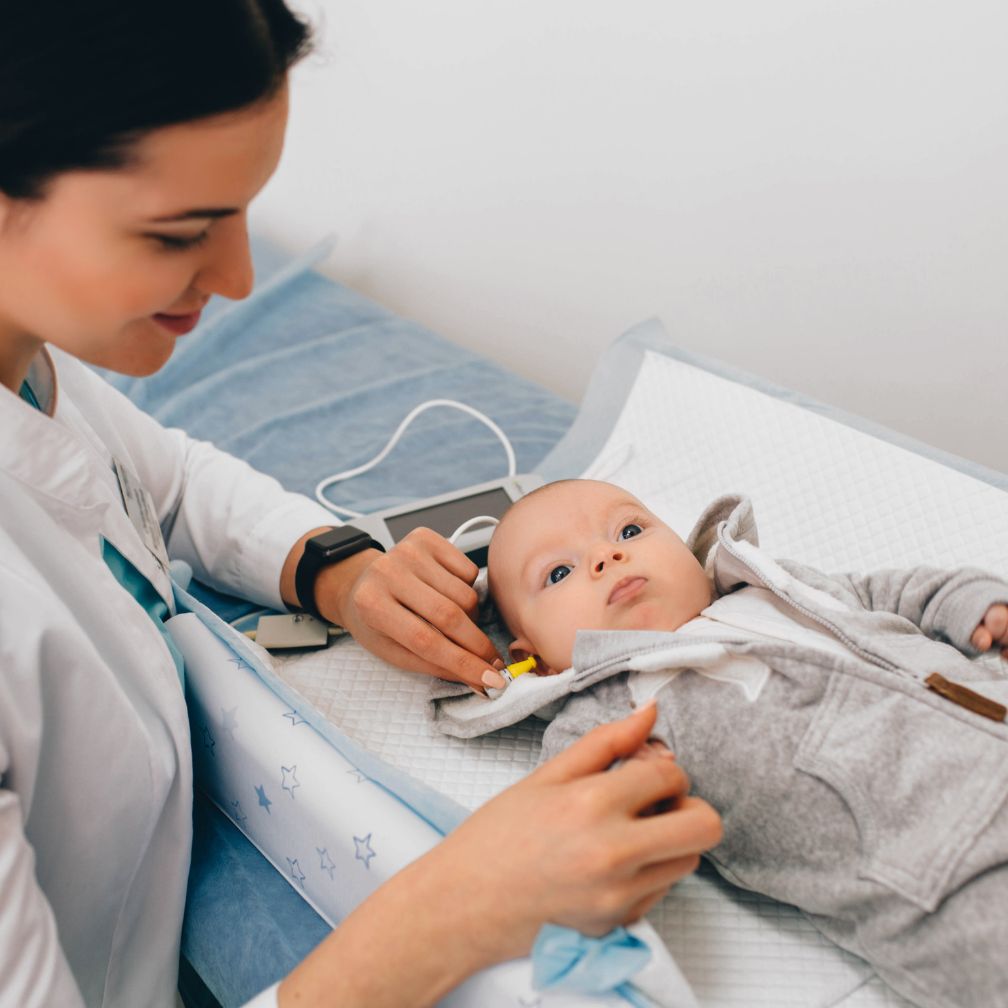
For guardians caring for an infant, recognizing that their infant suffers hearing impairment can trigger overwhelming feelings of anxiety. Fortunately, the reassuring perspective dictates that through timely checks and early help, babies with hearing issues will achieve profound developmental success. In truth, such babies can cultivate verbal abilities, social skills, and solid bonds within their surroundings, enjoying a rich existence!
Deploying personal hearing aids alongside cochlear implantation options yields two outstanding clinical approaches for guiding infants with hearing loss. In the section below, we examine their specific functions and explain how to determine the perfect fit for your infant.
Analyzing Infant Auditory Deficits
Hearing impairment across infants typically comes from several distinct health factors, such as:
- Key inherited genetic traits (even if family records demonstrate no precedent)
- Severe perinatal infectious diseases like cytomegalovirus (CMV) or rubella conditions
- Complex obstetric complications, such as systemic oxygen lack or low birth weight
- Certain intensive care medications administered in specialized newborn facilities
Which measure offers the greatest impact? Prompt clinical evaluation. This necessity explains why babies in United States hospitals complete hearing tests before going home with family. Certified pediatric audiologists active execute the standardized “1-3-6” care benchmark:
- Baseline screening completed before 1 month of life
- Definitive hearing diagnosis established prior to 3 months post-birth
- Direct clinical management (utilizing hearing tools or specialized rehabilitation) established prior to 6 months
Achieving these diagnostic benchmarks provides babies an ideal foundation for strong speech, linguistic, and brain development. Should you seek direction concerning these newborn checks, your primary pediatrician stands ready to assist you!
Pediatric Hearing Aids for Young Babies
For young children showing mild to severe auditory impairment, wearable hearing aids frequently remain the preferred initial approach. Such small, wearable instruments amplify acoustic signals, enabling babies to catch human speech and environmental audio more distinctly.
Hearing aids are:
- Dermatologically and structurally safe for young infants only a few weeks after delivery
- Manufactured with pliable, comfortable custom molds that adapt as the baby matures
- Equipped with child-proof battery covers and child-focused protective features
- Expertly tuned by a pediatric audiology specialist to match your baby’s exact hearing needs
Throughout early childhood growth, these hearing units require routine clinical adjustments to preserve physical comfort and functional efficacy.
Understanding Cochlear Implantation for Babies
When a baby is identified with profound to severe sensorineural hearing impairment and fails to show adequate progress with standard hearing aids, a cochlear device can be prescribed. Unlike conventional amplification tools, cochlear implants:
- Require surgical placement during a specialized medical procedure
- Safely route around damaged structures within the cochlear system
- Transform ambient sound into direct electrical pulses that stimulate the auditory nerve directly
Modern surgical cochlear systems operate as:
- Granted regulatory approval by the FDA for young patients reaching 9-12 months of age
- Extremely effective when integrated with early speech therapy and dedicated family support
- Prescribed solely after complete multi-disciplinary testing by an expert audiologist and ENT surgeon
This process includes neuroimaging scans, specialized auditory testing, and open dialogue concerning long-term communicative results.
Hearing Aids or Cochlear Implants: Distinguishing Features
- Mild to severe hearing loss targets Hearing Aids; Severe to profound hearing loss necessitates Cochlear Implants
- Non-Invasive external fitting: Hearing Aids; Surgical internal implantation: Cochlear Implants
- Physical sound amplification: Hearing Aids; Direct electrical signal generation: Cochlear Implants
- Usage can begin in early infancy: Hearing Aids; Starts at 9-12 Months: Cochlear Implants
Concluding Guidance on Pediatric Hearing Technology
If your infant is diagnosed with a hearing condition, you possess multiple viable options and compassionate guidance. Thanks to collaboration with dedicated pediatric audiologists, a vast majority of children attain speech and language milestones fully matching their playmates.
Whether your baby benefits most from custom hearing aids or a cochlear implant system, early intervention can make a lifelong difference.
Are you looking for clarity regarding your infant’s hearing development? Call our clinic today for a full evaluation and personalized care plan.